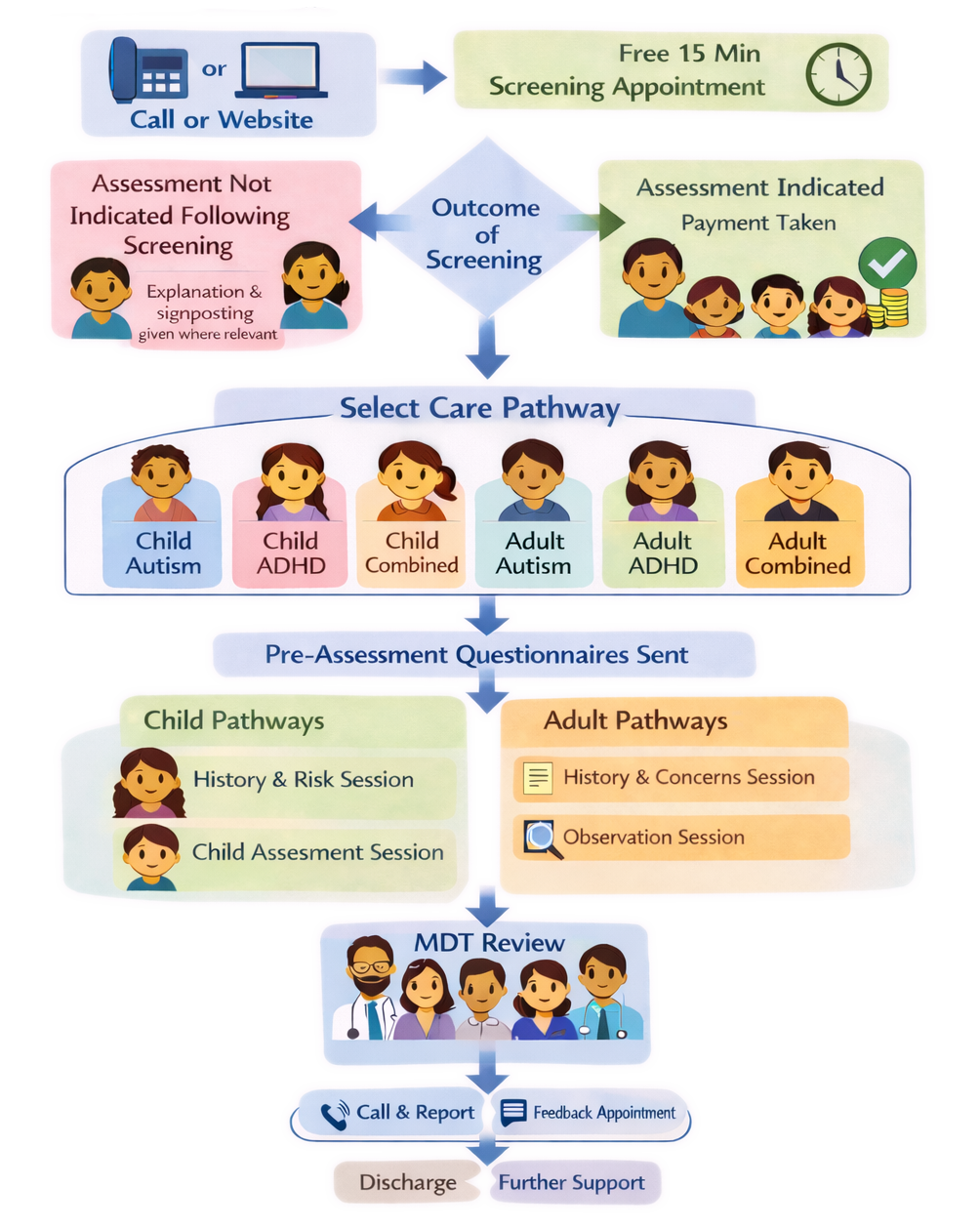
Our Assessment Pathway for Adults
We aim to make our assessment process clear, respectful, and flexible to individual needs. The pathway above shows what typically happens from first contact through to assessment, feedback, and next steps.
All adults are offered a free 15-minute screening appointment. This provides space to talk through your current concerns, ask questions, and explore whether an assessment may be helpful at this time. There is no expectation that you have everything worked out or that you can explain your experiences clearly from the outset.
If an assessment is not indicated following screening, this will be explained carefully and respectfully. Where helpful, we can discuss alternative options or suggest other sources of support.
If an assessment is indicated, payment is taken and you will be placed on the most suitable care pathway. Before assessment, you will be asked to complete questionnaires, which are reviewed by a senior clinician. These questionnaires help us build a fuller picture but are only one part of the overall assessment.
Assessment appointments are adapted to suit you. This may include pacing sessions over time, taking breaks, or approaching topics in a way that feels manageable. You are welcome to involve a partner, family member, or another person who knows you well, or to provide information in writing if that feels easier.
Once all assessment information has been gathered, it is reviewed by our multidisciplinary team. You can choose how you receive your outcome and written report, followed by a feedback appointment where findings, understanding, and recommendations are discussed.
Throughout the process, we aim to work collaboratively with you. You remain in control, and support is offered in a way that respects your experiences, preferences, and needs.
Is an assessment right for me?
Many adults consider assessment later in life after years of coping, adapting, or masking. Some people come with a clear sense that autism or ADHD fits their experiences, while others feel uncertain and are simply seeking understanding.
You may find an assessment helpful if:
- You have long felt “different” or out of step with expectations but have not been able to explain why
You have spent significant time masking, compensating, or pushing yourself to cope - Previous explanations or support have not fully made sense of your experiences
- You are seeking clarity to better understand yourself, your needs, or your history
- You want to explore whether a diagnosis could help with self-understanding, workplace adjustments, or future support
An assessment is not about proving anything or meeting a set standard. It is a structured and supportive process focused on understanding your experiences.
You do not need to be in crisis, and you do not need to have everything clearly worked out in advance.
It may also be helpful to know
- Some people pursue assessment primarily for clarity or validation, rather than a specific outcome
- Others find the process helpful even if a diagnosis is not made
- Choosing to explore assessment does not commit you to any particular next step
The aim is to support understanding, not to label or change who you are
Not sure yet?
If you are unsure whether assessment is right for you, the free 15-minute screening appointment offers space to talk things through, ask questions, and explore options without pressure.
There is no expectation to proceed beyond screening unless it feels right for you.
Many people tell us that simply having space to talk can be helpful, whether or not they decide to pursue assessment.