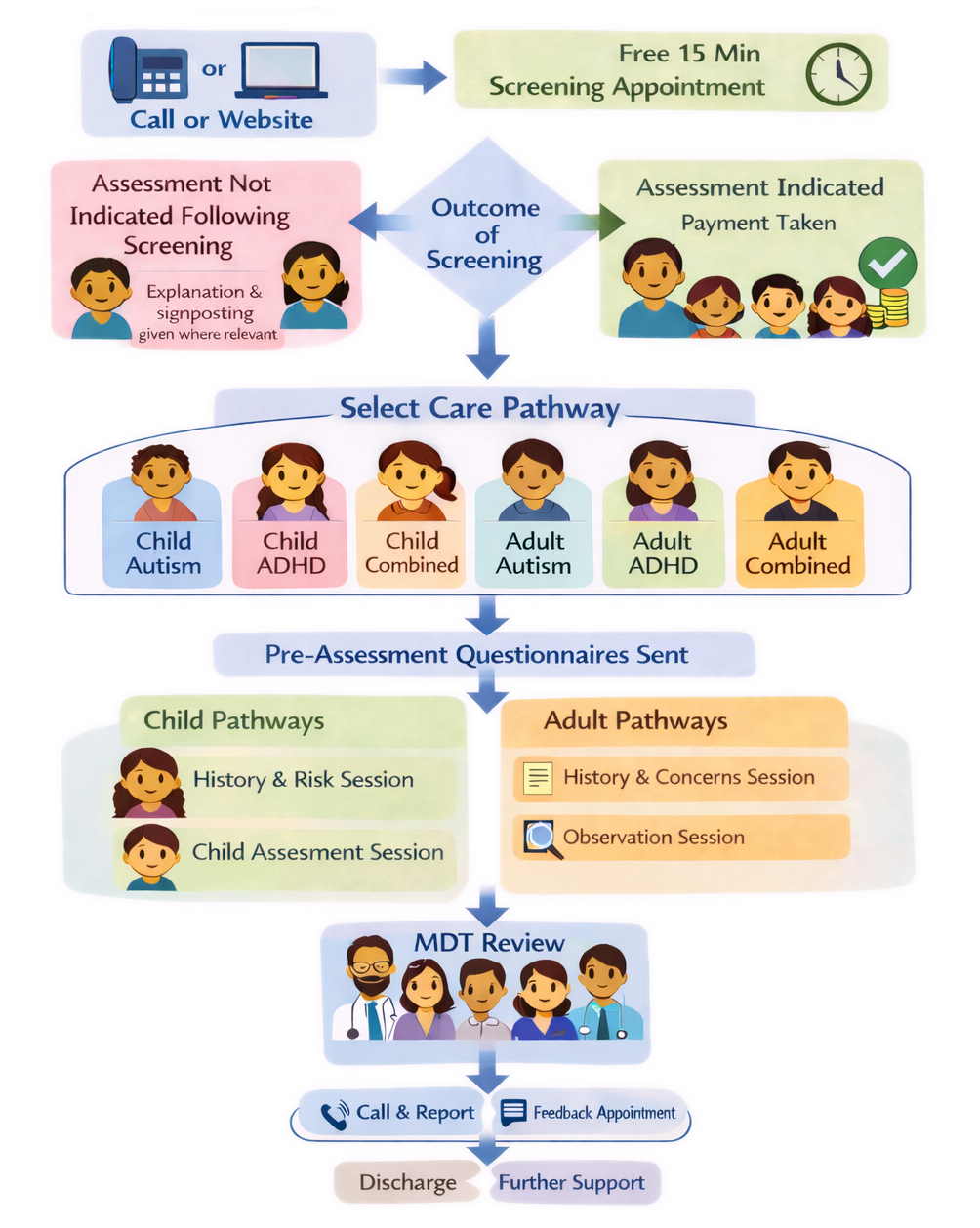
Your assessment journey
Sometimes grown-ups want to understand children a bit better — how they think, feel, and learn.This page explains what will happen and who you will meet.
Nothing will happen without your grown-up telling you first.
You only join the sessions that are meant for you.
01 First: your grown-up gets in touch
Your grown-up contacts the team by phone or the website.
You don’t need to do anything yet.
02 A short screening
Before anything else happens, your grown-up has a short online chat called a screening. You do not need to join this chat.
This chat is for grown-ups so that:
- the clinician can plan carefully
- you don’t have to answer lots of questions later
- things don’t feel rushed or surprising
You are not being judged or tested.
After the screening:
- sometimes an assessment is not needed right now, or
- sometimes an assessment would be helpful, and we get ready for the next steps.
03 Getting ready
If you’re having an assessment:
- your grown-up fills in some forms
- the clinicians read about you
- you’ll be told what will happen and who you’ll meet
Nothing will happen without you knowing.
You can choose:
- where you sit
- what helps you feel calm
- something to hold or play with
04 What is the history session?
The history session is a time when grown-ups talk together.
You do not need to be there for this session.
This helps the clinician learn about you without asking you lots of questions.
Grown-ups might talk about:
- when you were little
- what you were like growing up
- what helps you
- what feels tricky
While the history session is happening:
- you might be at school
- you might be playing or resting
- you don’t need to talk or answer questions
It is not a test, and you are not in trouble.
What if I feel nervous?
Feeling nervous is okay.
Lots of children feel a bit worried before meeting someone new or doing something different.
If you feel nervous:
- you can tell the clinician
- you can ask for a break
- you can hold something that helps you feel calm
- you can have your grown-up nearby
The clinician will go slowly and help you feel safe.
If something feels too hard, we can stop and talk about it
You don’t have to be brave all the time.
05 Meeting the clinician
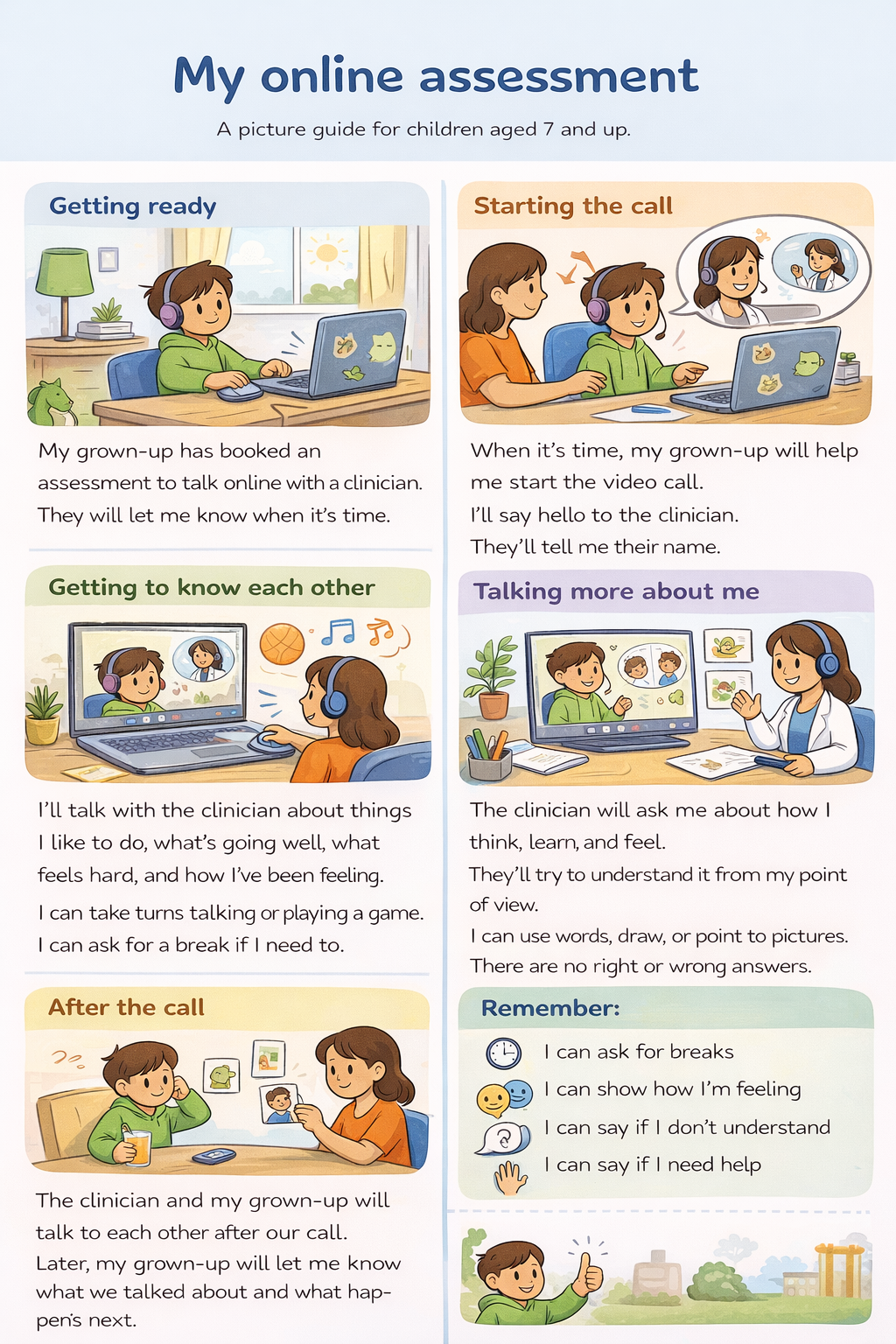
You will meet a clinician on a video call.
A clinician is a grown-up whose job is to:
- listen to children
- ask questions
- understand how children think and feel
Our team is made up of different clinicians — some are doctors and some are not.
Everyone wears normal clothes, not uniforms, and no one will ask to examine your body.
They are there to get to know you.
The call will last about the same time as a lesson or TV programme, with breaks if you need them.
What you might do
You might:
- talk
- play
- draw or write
- answer questions
- take breaks
There are no right or wrong answers.
You don’t have to look at the screen all the time.
06 The team talks together
After your sessions, the clinicians talk together as a team to understand you better.
They think about:
- what you find easy
- what you find tricky
- what helps you
07 What happens next
Your grown-up has a meeting to talk about:
- what was learned
- what it means
- how to help you
Your grown-up can explain this to you in a way that feels right.
Remember
- Your voice matters
- You can ask questions
- You can ask for breaks
- You can say if you don’t understand
- Nothing will happen without you knowing
- We will go at your pace
Visual guide
You can also look at our picture guide that shows what will happen step by step in your meeting with the clinician.